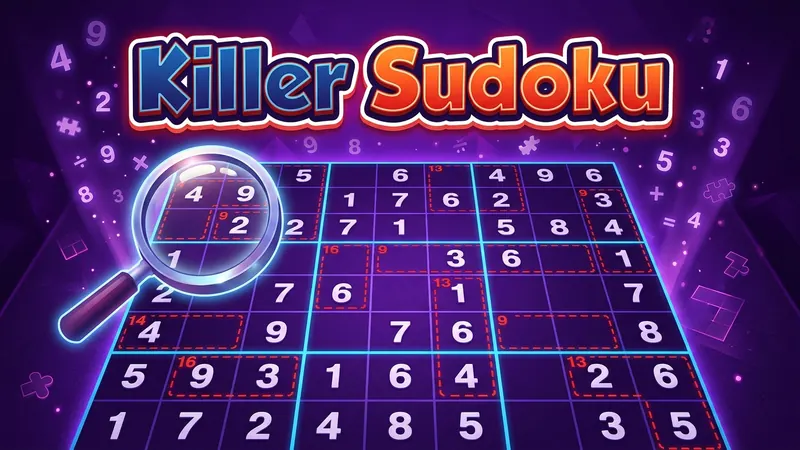
Puzzles start with only a handful of numbers on the board, so the cage totals are your main clues. Each puzzle has exactly one correct solution, reached by logic rather than guesswork.
How to play killer sudoku
- Fill every square with a digit from 1 to 9.
- Each row, each column and each 3 by 3 box must contain every digit exactly once, just as in ordinary sudoku.
- The grid is also covered by cages. A cage is a group of squares outlined with a dashed line, with a small total in its corner.
- The digits in a cage must add up to the total shown.
- No digit may appear twice inside the same cage.
Easy and Hard levels
Easy puzzles use mostly small cages of two or three squares, and a few numbers are already filled in to help you begin. Hard puzzles use bigger cages, mostly of two to four squares, and start with only a few numbers, so most placements come from the cage totals and the grid rules working together.
Controls and tools
- Click or tap a square to select it, then tap a number on the pad or press 1 to 9 on a keyboard.
- Move around the grid with the arrow keys, and clear a square with Backspace.
- Switch on Notes, or press N, to write small pencil marks. Notes are especially useful in killer sudoku.
- Tick Highlight mistakes to see a wrong number in red straight away.
- Press Hint, or H, once to see where to look, and again to fill the square in.
- Use Undo, or U, to step back through your moves. Restart clears the grid and New game gives you a fresh puzzle.
- Pause hides the board and stops the timer. Large makes the squares, numbers and cage totals bigger.
The 45 rule
The digits 1 to 9 add up to 45. That means every row, every column and every box also adds up to 45. This simple fact is the most useful tool in killer sudoku.
Suppose the cages lying wholly inside one box cover eight of its squares and add up to 38. The ninth square belongs to a cage that pokes outside the box. That lone square must be 45 minus 38, which is 7. The same trick works across a row or a column, and across two or three rows at once, where the total is 90 or 135.
Useful cage combinations
Some totals can only be made in one way. Learning a handful of these gives you a quick start on any puzzle.
Two-square cages
- A total of 3 must be 1 and 2.
- A total of 4 must be 1 and 3, because a digit cannot repeat.
- A total of 16 must be 7 and 9.
- A total of 17 must be 8 and 9.
Three-square cages
- A total of 6 must be 1, 2 and 3.
- A total of 7 must be 1, 2 and 4.
- A total of 23 must be 6, 8 and 9.
- A total of 24 must be 7, 8 and 9.
Strategy tips
- Start with the cages that have only one possible combination and write their digits as notes.
- Apply the 45 rule to every box, row and column early on. It often gives you a first number.
- Remember that a digit cannot repeat in a cage, which narrows the choices for larger cages.
- When a cage lies entirely inside one row, column or box, its digits are ruled out of the other squares there.
- Look at small cages first. A two-square cage has far fewer possibilities than a four-square one.
- Keep your notes tidy and update them each time you place a number.
Scoring
Every killer puzzle begins with 2000 points. You lose one point for each second, 50 for each hint and 25 for each mistake. The clock begins with your first entry and waits whenever you pause or leave the tab. Your best result is remembered by this browser, and the grid is saved as you go, so a refresh loses nothing.
Variations
If killer sudoku feels like a big step, try the ordinary easy, medium and hard sudoku pages first, or the daily puzzle for a single grid each day. Within killer sudoku itself, the Easy level is a good place to learn the cage combinations before you move on to Hard.
A short history of killer sudoku
Puzzles that mix sums with a grid have been around for a long time in various forms. Killer sudoku, as it is known today, is generally said to have become popular in newspapers in the mid-2000s, shortly after ordinary sudoku became a daily habit for many readers. It is sometimes called sum sudoku, and it has been a favourite with puzzle fans ever since.
Common questions
Do I need to be good at maths?
No. The sums are small, and you only need to add a few single digits. Most of the work is still placing numbers by logic.
Can a digit repeat inside a cage?
No. A digit can appear only once in each cage, as well as once in each row, column and box.
Why are there so few numbers on the board?
In killer sudoku the cage totals do the job of the givens. Easy puzzles include a few more numbers to get you started, while Hard puzzles include only a handful.
Does every puzzle have one solution?
Yes. Each puzzle is checked to make sure exactly one solution exists, so you never need to guess.
What is the best way to start?
Look for cages with only one possible combination, such as a two-square cage of 3, and use the 45 rule on the boxes.
How is my score worked out?
You start with 2000 points and lose one per second, 50 per hint and 25 per mistake. Your best result is stored on your device.