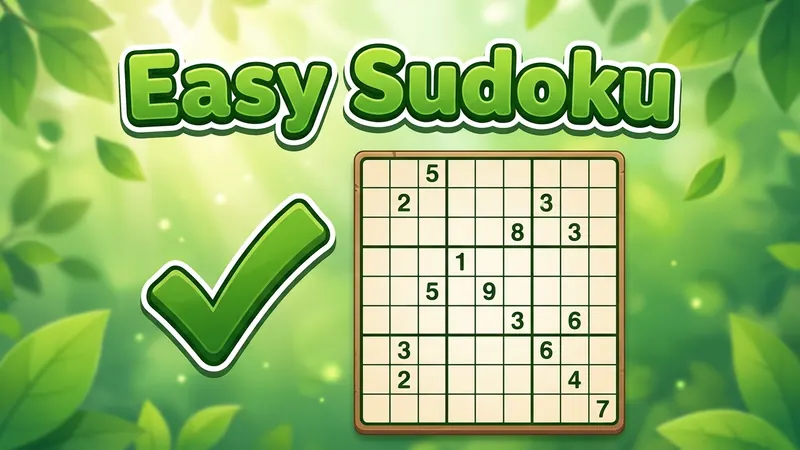
Each puzzle is generated fresh and has exactly one correct solution, so you will always have a clear route to the finish.
How to play sudoku
A sudoku grid has 81 squares arranged in nine rows, nine columns and nine smaller 3 by 3 boxes. Some squares already contain numbers, called givens. Your job is to fill every empty square with a digit from 1 to 9 so that each row, each column and each box contains every digit exactly once.
You never need arithmetic. Sudoku is purely about placement: where can this number go, and where can it not?
How to play on this page
- Click or tap a square to select it. The row, column and box light up, and matching numbers are highlighted.
- Tap a number on the pad, or press 1 to 9 on a keyboard, to fill the square.
- Switch on Notes to jot small candidate numbers in a square instead of committing to one.
- Use Erase or Backspace to clear a square, and Undo to step back through your moves.
- Keep Highlight mistakes ticked while you learn. A wrong number turns red as soon as you place it.
- Press Hint once to see where to look, and again to fill the square in. Hints reduce your final score.
The two techniques that solve every easy puzzle
Scanning for a hidden single
Pick a digit, say 7. Look at a box where 7 has not been placed yet. Use the 7s already in other rows and columns to rule out squares, as if drawing invisible lines across the grid. If only one square in the box survives, the 7 belongs there. Repeat for every digit and every box, row and column. Most of an easy puzzle falls to this one habit.
Looking for a naked single
Pick an empty square and ask which digits are still possible given its row, column and box. If eight of the nine are already visible, only one remains, and that square is solved. Squares with many neighbours already filled in are the best places to look.
A simple routine for easy sudoku
- Start with the digits that appear most often among the givens. They leave the fewest places to go.
- Work through each digit from 1 to 9 and place every single you can see.
- Move to the rows, columns and boxes that are nearly full and check what is missing.
- When you run out of obvious moves, switch on Notes and write the possible digits in the squares that are left.
- Whenever you place a number, glance at its row, column and box again. New singles often appear straight away.
Common beginner mistakes
- Guessing. If you have to guess, you have missed a clue. Look for another digit or region.
- Checking only the row or the column. A square must pass all three tests, including its box.
- Filling in notes everywhere too early. Notes are most useful when the grid is half finished and you are stuck.
- Giving up after one scan. A single new number can unlock many others, so keep going round again.
What makes a sudoku easy?
Difficulty depends on which techniques you need, not just on how many numbers are given. Our easy puzzles begin with about forty or more givens, and the generator checks that the whole puzzle can be finished using only the singles described above. When you are comfortable, step up to the medium level, where pencil notes become a necessity.
Where sudoku came from
The modern puzzle is generally credited to an American architect, Howard Garns, and first appeared in a puzzle magazine in 1979 under the name Number Place. It reached Japan, where a Japanese puzzle publisher gave it the name sudoku and made it a craze in the 1980s. In 2004 a newspaper in London began printing it daily, and within a few years it had spread to papers and phones around the world. Doing a puzzle each day is a popular, low-pressure way to keep your mind active.
Common questions
Do easy puzzles ever need guessing?
No. Every easy puzzle here is checked so that it can be completed with hidden singles and naked singles, with no trial and error.
Does each puzzle have only one solution?
Yes. The generator confirms that exactly one solution exists before it shows you a puzzle.
How do I use pencil notes?
Switch on Notes, then tap numbers to add or remove small candidates in the selected square. When you place a number, the matching note is removed from other squares in its row, column and box.
Can I switch off the red mistake highlighting?
Yes. Untick Highlight mistakes for a purer challenge. Your mistake counter still keeps track.
Is my puzzle saved if I leave?
Yes. Your grid, notes and undo history are saved in your own browser, so you can come back later and carry on.
How is the score worked out?
You start with 1000 points, lose a point for every second, 50 for each hint and 25 for each mistake. Your best score and time are stored on your device.